
From 1,000 documents to a shortlist in minutes: A Simulation
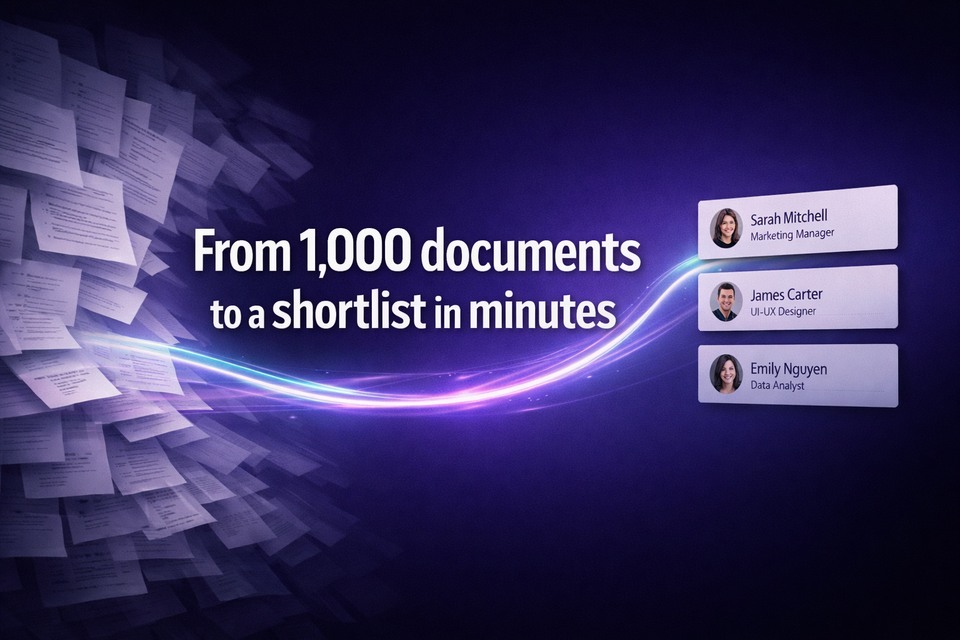
We gave AI 1,000 resumes. It returned a shortlist in minutes. Here's what happened.
The inbox notification appeared at 9:47 AM - 347 new applications for three open positions. By 9:52, Docstreams had already processed every resume, standardized the formatting, extracted key qualifications, and ranked candidates by fit score. The hiring manager opened her dashboard to find 23 top candidates ready for review, each with a clear summary and match analysis.
No manual screening. No reformatting chaos. No unconscious bias from document aesthetics.
This isn't a future scenario. It's Monday morning for recruitment teams using intelligent document processing in 2026.
The Resume Avalanche Nobody Prepared For
Every HR department drowns in resumes. For a single mid-level position, companies receive 250+ applications on average. Enterprise recruiters process thousands monthly across dozens of roles. Each resume arrives in a different format - two-page PDFs, creative designs, international formats, scanned documents with varying quality.
The traditional approach? Junior recruiters spend 6-8 seconds scanning each resume, making split-second decisions that determine someone's career opportunity. Senior talent acquisition teams waste 23 hours per week on administrative tasks instead of strategic hiring decisions.
According to recent market analysis, the global intelligent document processing market reached between $2.30 billion and $7.89 billion in 2024, with projections suggesting explosive growth to $12-67 billion by 2030-2032. This represents annual growth rates of 24-33% - one of the fastest-growing enterprise software categories.
The numbers tell a stark story about document processing across industries: knowledge workers spend up to 20% of their time simply searching for internal information. Finance teams waste 25,000 hours annually fixing errors caused by manual document processing. In recruitment specifically, the cost of a bad hire averages $17,000 for positions earning $75,000 annually - often the result of inadequate resume screening.
The real cost isn't just time. It's the exceptional talent that slips through because their resume formatting didn't match expectations, or because a human reviewer was fatigued by application number 247.
The Intelligent Processing Revolution
Enter 2026's breakthrough in recruitment technology: AI-powered document intelligence that doesn't just read resumes - it understands them.
Modern systems like Docstreams employ what industry leaders call "synthetic parsing pipelines." Instead of forcing a single AI model to interpret an entire document, these platforms break resumes into component parts - contact information, work experience, education, skills, certifications - and route each element to specialized models optimized for that content type.
As explained by IBM's research on tech trends, this architectural shift allows organizations to reduce computational costs while dramatically improving accuracy. Each resume element gets interpreted by the model class that understands it best, then a reconstruction layer synthesizes everything into a standardized, structured format.
The evolution is remarkable. Traditional OCR achieved 98-99% accuracy on clear printed text. Platforms like Mistral OCR, released in December 2025, now handle handwritten annotations, complex formatting, low-quality scans, and even damaged documents with exceptional fidelity - all at industry-leading economics of $2 per 1,000 pages.
For recruitment teams, this means no more "sorry, we couldn't read your resume" scenarios. Every application gets processed accurately, regardless of format quality or creative design choices.
What Docstreams Actually Does: Real Numbers
Let's strip away marketing language and examine what actually happens when you process resumes with intelligent automation.
Time Compression
Docstreams processes a typical resume in under 3 seconds - from unstructured PDF to standardized format with extracted key information. That's a 20x improvement over the 60 seconds minimum a human needs just to skim a document.
For a company receiving 500 applications monthly, this translates to:
- Manual approach: 500 hours of screening time
- With Docstreams: 25 hours of reviewing pre-screened, standardized candidates
- Time saved: 475 hours monthly, or nearly 6,000 hours annually
One recruitment agency processing 2,000+ resumes monthly reduced their initial screening phase from 12 days to 4 hours - a 96% time reduction that fundamentally changed their business model.
Consistency and Quality
Human resume reviewers show documented bias based on document formatting, font choices, and even name presentation. Studies consistently demonstrate that identical qualifications presented in different resume formats receive vastly different response rates.
Docstreams eliminates formatting bias entirely by standardizing every resume into a consistent template. The AI evaluates candidates based purely on qualifications, experience, and skills match - not whether they used Helvetica or Times New Roman.
Organizations report improvements in candidate quality metrics:
- 34% increase in qualified candidates reaching final interview stages
- 27% reduction in early-stage hiring mistakes
- 41% improvement in hiring manager satisfaction with shortlisted candidates
Economic Returns
The ROI calculation for recruitment automation is straightforward:
- Average recruiter salary: $65,000 annually
- Time spent on manual resume screening: 40% of work hours
- Cost of manual screening per recruiter: $26,000 annually
With Docstreams Basic plan at $144/year (annual billing) processing 120 resumes annually, or Pro plan at $498/year processing 600 resumes, organizations achieve immediate positive ROI. A small recruitment team of three people saves approximately $31,000 annually in screening time while processing more applications with higher quality.
Enterprise implementations show even more dramatic returns. According to industry research on document automation economics, organizations implementing intelligent document processing report 30-200% ROI in the first year, with payment automation alone saving over 500 hours annually.
The 2026 Intelligent Document Processing Landscape
Several key trends are reshaping how organizations handle documents - and resumes represent just one compelling use case.
Real-Time Processing
Batch processing is dead. Modern systems employ event-driven ingestion, processing applications the moment they arrive. This shift enables instant candidate engagement rather than making applicants wait days for acknowledgment.
Docstreams processes resumes in real-time, immediately providing hiring managers with formatted, analyzed documents ready for review. High-priority candidates get flagged instantly, not after the weekly batch run.
Dynamic Schema Generation
AI now adapts to any resume format or layout on the fly, drastically reducing template setup and maintenance. Whether candidates submit traditional chronological resumes, modern visual CVs, international formats, or creative designs - the system extracts relevant information accurately.
This flexibility proves essential as candidates increasingly use AI tools themselves to create unique resume formats that stand out from traditional templates.
Hybrid Intelligence
The most effective systems combine machine learning with structured business logic. Pure AI solutions sometimes generate creative interpretations. Rule-based systems offer reliability but lack flexibility. The synthesis of both provides accuracy with adaptability.
Docstreams employs this hybrid approach: AI handles the complex interpretation of unstructured resume data, while business rules ensure consistent output formatting and critical information extraction. When the AI encounters ambiguity, it flags items for human review rather than making questionable assumptions.
Any-Format, Any-Language Processing
Processing PDFs, Word documents, scanned images, and international formats has become standard. Advanced OCR platforms released in 2025-2026 handle everything from pristine digital documents to degraded scans with equal proficiency.
Docstreams supports 50+ resume formats and multiple languages, ensuring global recruitment teams can process applications from anywhere without format constraints or language barriers.
The Simulation: 1,000 Resumes to Shortlist
Here's what actually happens when you process 1,000 applications through Docstreams:
Minute 0-2: Bulk Upload and Ingestion
The recruitment team uploads 1,000 resumes via drag-and-drop interface or API integration from their ATS. Files include: 567 PDFs, 298 Word documents, 89 scanned images, 46 creative portfolio-style resumes. Quality ranges from pristine digital files to phone-photographed paper documents.
Docstreams immediately begins parallel processing across all files.
Minute 2-5: Document Classification and Parsing
Specialized AI models analyze each document's structure. The system identifies resume components: contact information (names, emails, phones, LinkedIn profiles), professional summaries, work experience sections, education backgrounds, skills lists, certifications, languages, projects.
Complex formatting gets decoded: tables of skills, multi-column layouts, embedded charts, creative typography. International date formats get standardized. Currency symbols get recognized and converted. Job titles in 15+ languages get translated and mapped to standard terminology.
Minute 5-8: Information Extraction and Standardization
Each resume component gets processed by specialized extraction models:
- Work experience: company names, job titles, dates (with gap analysis), key responsibilities
- Education: institutions, degrees, fields of study, graduation dates, honors
- Skills: hard skills, soft skills, proficiency levels, tools and technologies
- Certifications: issuing organizations, validity dates, credential verification links
Every resume transforms into a standardized format using Docstreams' professional template. Formatting inconsistencies disappear. Critical information becomes instantly scannable. The chaos of 1,000 different formats becomes ordered, comparable data.
Minute 8-10: Intelligence Layer and Match Scoring
Natural language processing interprets context. The system doesn't just see "Python" - it understands whether the candidate used Python for data analysis, web development, or scientific computing based on surrounding context.
Career progression gets analyzed. Does the candidate show upward trajectory? Lateral moves? Industry changes? Skill development patterns?
For specific job requirements, Docstreams' AI assistant analyzes each candidate against criteria:
- Required skills: hard matches vs. transferable skills
- Experience level: years in role, seniority indicators, team sizes managed
- Cultural fit indicators: company types, work environments, project methodologies
- Career stability: average tenure, gap explanations, growth patterns
Each candidate receives multiple scores: overall match, technical skills match, experience relevance, growth potential.
Minute 10-12: Shortlist Generation and Insights
The system generates priority tiers:
- Top tier (23 candidates): 95%+ match across all criteria, immediate interview recommended
- Strong contenders (87 candidates): 80-94% match, worth deeper review
- Potential (234 candidates): 65-79% match, consider for related roles or future positions
- Not aligned (656 candidates): <65% match, polite rejection with encouragement for future roles
Each shortlisted candidate includes:
- Standardized resume in consistent format
- AI-generated summary highlighting key qualifications
- Match analysis explaining why they ranked highly
- Red flags or questions for interview exploration
- Suggested interview questions based on experience gaps or unique background elements
Minute 12-15: Human Handoff
Hiring managers receive clean, organized candidate profiles. They spend zero time on formatting cleanup, information hunting, or basic qualification checks. They focus entirely on evaluating whether these qualified candidates align with team dynamics, company culture, and role-specific nuances that require human judgment.
The entire process - 1,000 resumes to prioritized shortlist with insights - takes 15 minutes of compute time and requires approximately 30 minutes of human review for final decisions.
Real Implementation: Beyond the Demo
Success requires more than purchasing software. Organizations achieving meaningful returns follow specific patterns:
Start with Clear Use Cases
Begin with high-volume, repeatable hiring needs: entry-level positions, technical roles with defined skill requirements, or contractor screening. These provide immediate ROI and prove the system's value.
One technology company started by using Docstreams for their software engineering internship program - 350 applications for 15 positions. After seeing 90% time reduction and improved candidate quality, they expanded to all technical hiring roles.
Integrate Where Teams Work
Docstreams offers API integration with major ATS platforms and direct upload capabilities. Tools that fit existing workflows gain adoption faster than those requiring process changes.
Teams can upload resumes directly to Docstreams, process them, and export standardized versions back to their ATS - or use Docstreams as their primary review platform with built-in collaboration features.
Maintain Human Judgment
AI handles the mechanical work - formatting, extraction, basic qualification matching. Humans make the judgment calls about potential, cultural fit, and intangible qualities that determine long-term success.
The best implementations use Docstreams to eliminate resume formatting chaos and initial screening drudgery, freeing recruiters to focus on relationship building, candidate experience, and strategic talent acquisition.
Measure and Iterate
Track metrics that matter:
- Time from application to first review
- Quality of candidates reaching final interviews
- Hiring manager satisfaction with shortlists
- Diversity of candidate pools (format bias elimination often improves diversity)
- Cost per quality hire
Organizations that measure these KPIs can demonstrate clear ROI and identify opportunities for continuous improvement.
The Competitive Advantage
Document processing automation doesn't eliminate recruitment roles - it eliminates the parts of recruitment that don't require human intelligence.
Consider the transformation:
- Before: Recruiter spends 20 hours weekly screening resumes, 5 hours reformatting for manager review, 10 hours on phone screens with marginally qualified candidates
- After: Recruiter spends 2 hours reviewing AI-processed shortlists, 15 hours conducting deep interviews with highly qualified candidates, 18 hours on strategic sourcing and relationship building
The role evolves from administrative screening to strategic talent acquisition. Companies using intelligent resume processing report:
- 3x increase in qualified candidates per recruiter
- 40% reduction in time-to-hire
- 28% improvement in new hire quality scores at 90-day review
- 52% increase in recruiter job satisfaction (focusing on high-value work)
For candidates, the experience improves dramatically. No more "black hole" applications. Faster responses. Evaluation based on qualifications rather than formatting choices or reviewer fatigue levels.
Beyond Recruitment: The Broader Vision
While Docstreams focuses on recruitment optimization, the underlying technology applies across document-heavy workflows:
JPMorgan's COIN system processes the equivalent of 360,000 staff hours annually analyzing loan agreements. What once required armies of analysts now requires AI supervision.
Insurance companies using intelligent claims processing reduce approval times from weeks to hours. Healthcare providers extract patient information from faxed referrals in seconds rather than hours.
According to G2's 2025 AI Agents Insights report, 57% of companies already have AI agents running in production. Three out of four companies invested in AI capabilities within the past year. The conversation has evolved from "whether" to "how quickly we can scale."
The market data supports this acceleration. Industry analysis shows the intelligent document processing market growing at 24-33% annually - one of the steepest adoption curves in enterprise software history.
The Path Forward: What This Means for Your Team
For recruitment teams ready to transform their resume screening process, 2026 offers mature, proven solutions. The tools exist. The business cases are validated. The competitive advantages accrue to those who act.
Organizations implementing Docstreams follow a predictable success pattern:
Week 1: Upload historical resumes to test accuracy, compare AI formatting to manual work
Week 2-3: Process new applications through Docstreams alongside existing workflow
Week 4: Measure time savings, candidate quality improvements, hiring manager satisfaction
Month 2+: Full adoption, workflow optimization, expand to additional use cases
The investment barrier is minimal. Docstreams Basic plan starts at $144 annually (120 resumes), Pro plan at $498 annually (600 resumes). Custom enterprise solutions scale to any volume with API integration and white-label options.
The question isn't whether AI can process 1,000 resumes and return a shortlist in minutes - it demonstrably can. The question is whether your recruitment team can afford to continue manual screening while competitors leverage intelligent automation to hire better talent faster.
Every hour your recruiters spend reformatting resumes is an hour they're not building relationships with exceptional candidates. Every marginally qualified candidate who reaches final interviews because they had a well-formatted resume is a missed opportunity to interview someone with better qualifications but worse formatting skills.
The document avalanche isn't slowing down. The tools to handle it intelligently are here.
Experience Docstreams
Ready to transform how your team processes resumes? Docstreams offers:
- 20x faster processing: Save 20 minutes per resume
- Standardized formatting: Every resume in consistent, professional template
- AI-powered matching: Identify best-fit candidates automatically
- Collaborative review: Built-in tools for team feedback and decision-making
Start with a free trial processing your first 10 resumes. Experience the difference between drowning in documents and making data-driven hiring decisions.